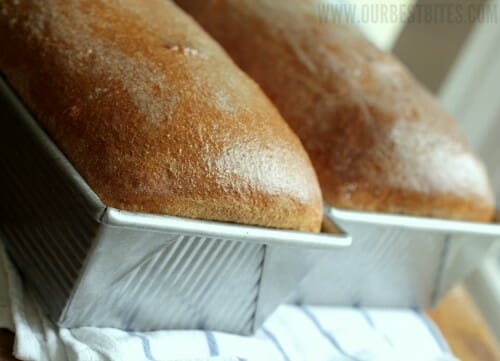
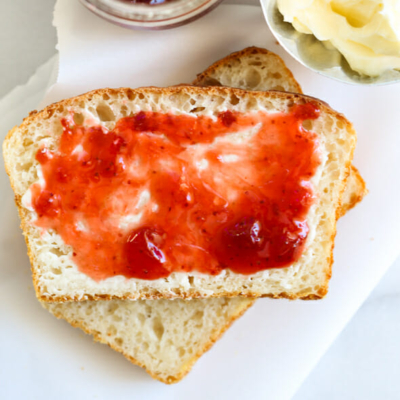
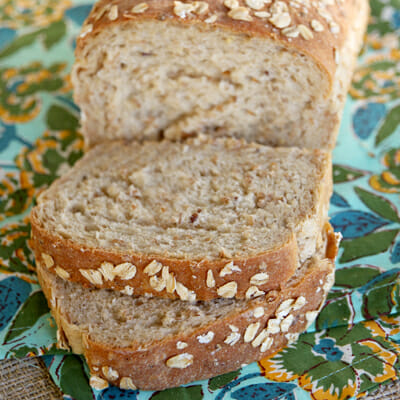
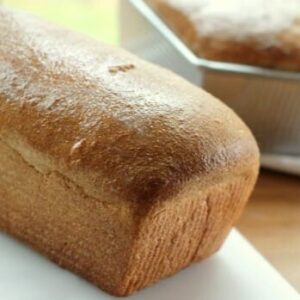
We’ve gotten lots of requests for a good whole wheat bread, so here’s my go-to Honey Whole Wheat Bread recipe. This recipe is for you batch bakers who want to get the most out of your time in the kitchen! It makes 4 generously sized loaves of deliciously soft, slightly sweet whole wheat sandwich bread for all of your freshly baked bread needs. It’s perfect for sandwiches and toast and it’s not too dense or heavy, yet it still holds up well to slicing. In my humble opinion, it’s the perfect whole wheat bread.
I started with a great recipe from Bosch and tweaked and changed things until I felt like they were exactly right. I love the method here because it only has one rise and goes straight from the mixer to the baking pans. That means you aren’t going to be waiting all day to dig in that freshly baked bread. I hope you love it as much as we do!
Ingredients and Equipment Needed
This is just a preview of ingredients and method, keep scrolling for full printable recipe.
Ingredients
- Whole wheat flour – You don’t need to grind your own wheat, but I really do think you wind up with better-tasting (and supposedly more nutritious) flour. If I am going to grind my own (I use a WonderMill) I order hard white wheat. I find it milder and softer than red wheat, and produces a lighter finished product.
If you are buying flour, look for white whole-wheat flour, which is ground from hard white wheat. Regular whole wheat flour will work but it has a stronger flavor and may not be quite as light and fluffy. If you can find whole wheat bread flour, that’s another great option. - Warm water – Warm water is used to activate the yeast. Too cold and you won’t get a good rise, too hot and you’ll kill your yeast. Aim for 105-115°F water.
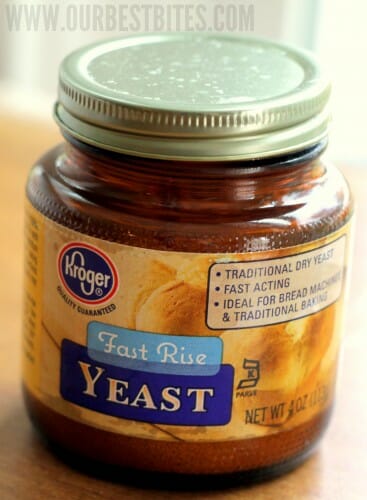
- Bread machine yeast – Also labeled “rapid rise” or “instant” yeast.
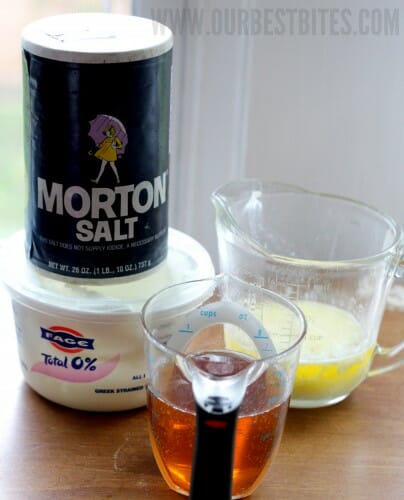
- Table salt
- Unsalted butter – The amount of salt in salted butter can vary, so using unsalted butter lets us control the amount of salt in the recipe. If all you have is salted, that’s ok. Just reduce the additional table salt to about 2 3/4 teaspoons.
- Honey – Honey adds a subtle sweetness and helps the crust brown.
- Plain Greek yogurt – The original recipe called for a dough enhancer, which is an ingredient that most people don’t have laying around and can be hard to track down. plain Greek yogurt gives us some of the same benefits in a much easier-to-acquire package. The acidity supports the structure of the dough and the protein, milk solids, and fat contribute to the overall moisture and tenderness of the final bread.
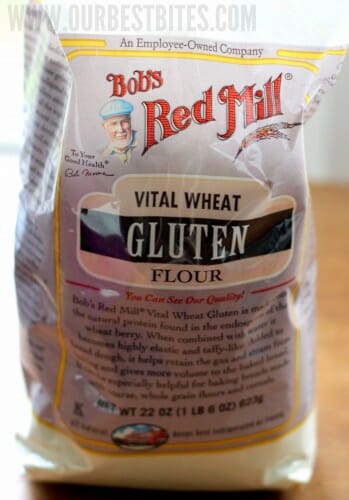
- Vital wheat gluten – Vital wheat gluten is the concentrated protein from wheat flour and it’s often sold near the specialty flours on the baking aisle. This is what gives bread dough it’s strength and elasticity. Using whole wheat can interfere with the gluten development in the dough, preventing it from properly trapping the gasses created by the yeast, which results in a poor rise and dense, crumbly bread. Using it here allows us to get all the of the benefits of using whole wheat while avoiding some of it’s potential pitfalls. If you can’t find it easily, or you don’t have it at home and you want to try this recipe anyway, you can sub in some bread flour for a portion of the whole wheat flour. See the notes in the recipe card at the end of this post for full instructions. If you’re using 100% whole wheat flour, do not skip the vital wheat gluten!
Equipment
- Heavy duty mixer – Note that this is a big batch of bread (we’re starting with 9 cups of flour and then add more)! I’m using a Bosch mixer for this. If you are using a KitchenAid mixer or other standard size mixer, check your max capacity before you begin. You can also check the frequently asked questions and recipe card below for options on shrinking the recipe down. I would recommend a 2-loaf batch if you have a KitchenAid mixer.
- Bread pans – I use and love these pans. I bought them on Amazon and yes, they are a little spendier than your average bread pans. But if you’re serious about making your own bread, they are fabulous at retaining heat, giving you a nice, smooth, evenly-browned loaf of bread.
How to Make Honey Whole Wheat Bread
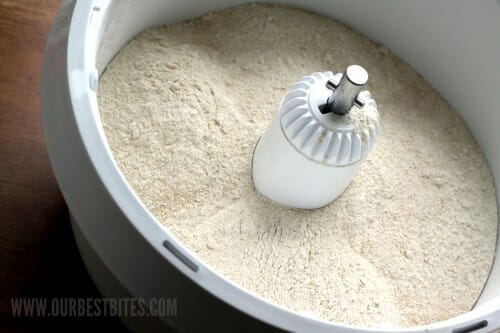
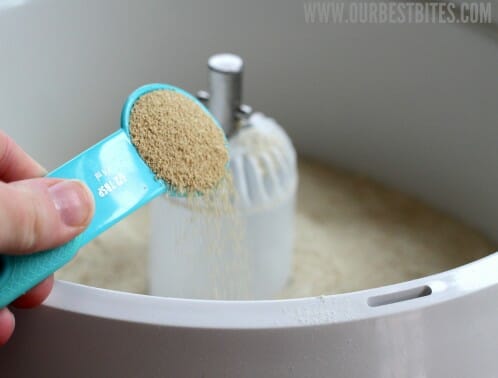
- You’ll start with some flour, rapid-rise yeast, and warm water in the bowl of your mix. That needs to sit for a minute until the yeast wakes up and the whole thing looks bubbly and spongey.
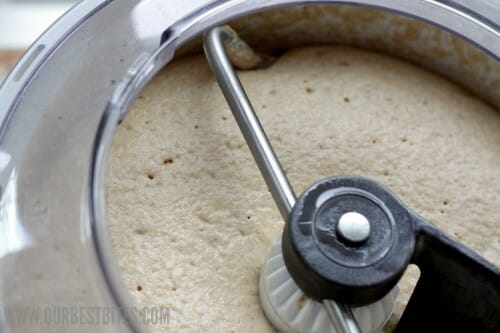
- At this point you’ll add some salt, butter, honey, Greek yogurt, and vital wheat gluten. Then you’ll slowly add several additional cups of flour, until the dough starts pulling away from the sides of the bowl.
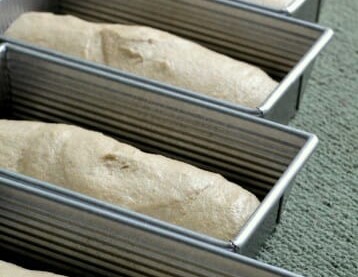
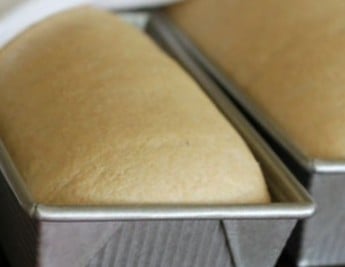
- You’ll let that knead for a few minutes right in the mixer, then transfer to a greased surface to divide into 4 equal potions. Each of those portions will then go into a greased bread pan to rise for about an hour. This is the only rise, which is one thing I love about this recipe!
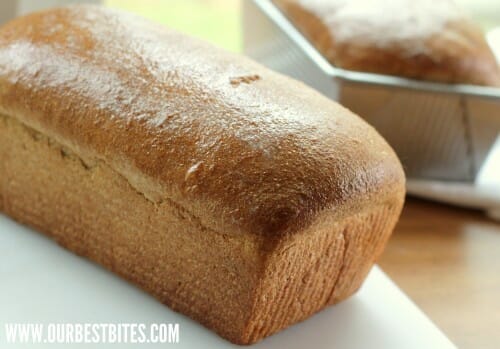
- After that, they are ready to go into a hot oven until golden brown! A quick rub of cold butter over the hot tops while fresh out of the oven finishes them off.
- You’ll allow the loaves to cool all the way in the pans, and then they are ready for use or storage for later!
Storing and Other Tips
- Store completely cooled bread in a tightly sealed plastic bag or airtight container at room temperature and enjoy within 3-4 days for best results.
- These loaves freeze beautifully. You can use gallon-sized Ziploc bags (you may have to cut the ends off), or you can buy bread bags. Again, if you live somewhere where lots of people make their own bread, you might be able to buy them locally. Otherwise, these bags from King Arthur Flour are fabulous.
Frequently Asked Questions
Some people are successful at making whole wheat bread without it. However…part of our job is making our recipes something that beginners to experts can make, and can make well on a consistent basis. Because of variations in bread-making experience, wheat quality, different types of wheat, whether you grind it yourself or buy the flour at the store, elevation, and about a million other factors, there’s lots and lots of potential for this recipe to fail. Vital wheat gluten helps with that. It’s not going to hurt you or your bread (unless, like a commenter mentioned, you’re allergic or have Celiac Disease), but it can help level out some of those problematic factors, so I guess my thing is why not add it, you know?
Yes, especially if you have a pro-series mixer. That said, you’ll want to keep an eye on your machine, especially near the end of the kneading cycle. If it smells “machiney” or appears to be straining or overheating, turn it off and finish kneading it by hand.
Yes, absolutely! During the final kneading, just double the kneading time. Also, there’s a tendency when making bread without a mixer to add too much flour because you can really feel the moisture of the dough. Just realize that as time goes on and the longer the bread is kneaded, it will become less and less sticky, so try and be patient before adding too much flour.
Of course not! The easiest way to adjust the ingredients needed for the number of loaves you want is to press the + or – button on the recipe card to the number of loaves you’d like to make. Since the customary US measurements do not divide cleanly, the best way to measure is to click on “Metric” under the ingredients list on the recipe card below and measure all ingredients by weight in grams.
I would estimate 16 standard slices per loaf at normal sandwich thickness.

Honey Whole Wheat Bread
Ingredients
- 12-15 cups whole wheat flour preferably hard white wheat
- 5 ¾ cups warm 105-115 F water
- 2 ½ tablespoons bread machine or instant yeast
- 2 tablespoons table salt
- ½ cup unsalted butter melted
- ⅔ cup honey
- ¼ cup plain Greek yogurt
- 2 heaping tablespoons vital wheat gluten
Instructions
- Mix 9 cups wheat flour and yeast in the bowl of a heavy-duty mixer. Add the warm water and mix well. Cover and allow to rise for 15 minutes.
- Add salt, honey, melted butter, yogurt, and vital wheat gluten. Mix well. Add remaining 3-6 cups of flour, mixing the dough at low speed, until the dough pulls away from the sides of the bowl and the dough barely sticks to your finger. Allow the mixer to knead the dough for an additional 5 minutes.
- While the dough is kneading, spray 4 9×5″ bread pans with non-stick cooking spray. Set aside. Spray a work surface and your hands with non-stick cooking spray.
- Turn the dough onto the prepared work surface. It should be very easy to work with. Press the dough into an even circle or square and divide the dough into 4 equal pieces. Press the dough into a rectangle that is about 8½-9" on the long side. Roll it into a smooth log and place into a prepared pan. Repeat with remaining dough pieces. Cover and let rise for 45-60 minutes or until the dough is rounding over the tops of the pans.
- Carefully place the pans onto the middle rack of a cold oven. Turn oven onto 350℉ and bake for 32-40 minutes or until the tops are golden brown and, if you're feeling awesome, an instant-read thermometer reads 200℉. Remove from oven and run a stick of cold butter over the tops of the bread. When cool, remove from pans. Use immediately or freeze loaves for future use.
Notes
- Nutritional information reflects 1 loaf of bread, not an individual serving size.
No Vital Wheat Gluten?
- If you cannot get vital wheat gluten, use your whole wheat flour for the initial mix and then use white bread flour for the additional flour, only as much as needed to obtain a dough that is pulling away from the sides of the bowl and behaving as the directions above instruct.
- All purpose flour may be used this way as well, but the bread flour will provide better structure and rise.
- You can also use 100% whole wheat bread flour in place of all the flour and omit the vital wheat gluten.









Questions & Reviews
Girl, did you realize you would get soooo MANY comments when posting about the holy mecca of all Mormondom–wheat bread!!?? Everybody has an opinion.
I have been using this same Bosch recipe for a few years and love it. (I add 3 T. of salt as I think only makes it flat. And 1 cup honey. Maybe others will love it now thanks to you.) I use the exact same amount of flour as you do but get six loaves in my 8×4 pans. My kids eat smaller sandwiches better. See? I have an opinion too. You ladies rock!
Ummm, the secret #1 reason why I’ve put off posting a whole wheat bread recipe was because I was sure at least 50% of the comments would be people tellig me I was doing it wrong, haha!
How did you know? You must be feeling extra close to the Spirit (GC was wonderful, yes?), because I have become disenchanted with my current bread recipe and need a good new one by this weekend. I will finally buckle and get that gluten stuff, just because I trust you. THANKS!
So, let’s just say that a girl was Bosch-less. How hard/possible would it be to make this recipe by hand? I currently make my white bread by and and it works fine, but it sounds like wheat bread dough has a different consistency. Would the old hand-mixed/kneaded method work?
You can definitely make it by hand! 🙂 It’s just going to take a little more elbow grease, especially in the final kneading (knead it twice as long as you would with the machine). Also…stay tuned for a little g-i-v-e-a-w-a-y tomorrow… 🙂
Yeah! I have plenty of elbow grease! But, I wouldn’t say no to a giveaway, either…
Tara D. I have never had a Bosch and my Kitchen Aid is too small to make bread. I have a large stainless steel bowl that I have been making wheat bread in for 20 years. It works great!! Give it a try.
We are fans of Red wheat at my house because we like its nutty flavor best, and find the white wheat to be kind of bland, but I have found that we are the exception here. . . most people that have used both seem to like white wheat best. Also, I have had really crappy wheat for about a year, and I just ordered Hard Red Spring wheat (read: Not Winter) that had a guaranteed protein content of 15.5%, and I have found that if your protein content is high, which spring wheat tends towards, your bread will develop the gluten it needs without adding extra gluten flour. My crappy wheat had a really low protein content, and I caved and bought gluten flour, and even adding a full cup of it to a bosch-full of dough, my dough never seemed to develop enough gluten, and would come out of the oven lumpy and weird. Anyway, my awesome wheat now is baking up 4 huge, light, beautiful and soft loaves right now in my oven:)
Can you use whole wheat pastry flour instead of whole wheat and the gluten?
Nope- pastry flour is from soft wheat, instead of the hard winter wheats and has less protein and less gluten. It would not rise well or have a typical bread texture. Maybe you could use pastry flour with EXTRA gluten, but I don’t know.
I have been making bread for a while now and I absolutely LOVE your 7 grain recipe. I have been meaning to try it with 100% whole wheat. It is probably my favorite bread recipe. I also grind my own wheat, but usually grind at least twice as much as I need for the recipe so that I don’t have to do it the next time because that makes me more motivated to actually make the bread the next time instead of running to the store. I just keep the wheat flour in the freezer to keep it fresh. Also, my mom has been making bread for years and always uses hard red wheat. I like hard white better but my mom’s bread is amazing with hard red. She usually adds some canned pumpkin to make it more moist. It’s probably the best bread I have ever tasted. And one more thing, kneading the bread a bit longer helps to release the gluten in the flour. I usually let my kitchen aid mix it for 5-10 minutes after all the flour is incorporated.
Kristine, could we get a copy of your 7 grain recipe and your mom’s with the pumpkin? Thanks
I have had a Bosch mixer forever. When I first got married, my mother gave me hers- which I passed on to my daughter when I found a red Bosch mixer in my local Bosch store in Arizona and couldn’t resist (because it was red and I really did deserve a red Bosch mixer). Both mixers- the one that is 40 years old and the one that is 5 years old work perfectly and I wouldn’t have anything else. For making bread, as far as I am concerned, there is nothing better. The Bosch makes it so easy that there is no reason to not make homemade bread! My 21 year old college senior daughter who has custody of the older Bosch mixer makes her own cracked wheat bread all the time now. I will be giving this recipe a try too. Thanks!
Re: Amanda about the greek yogurt: greek-style yogurt has more fat and less water. My very similar recipe calls for regular (PLAIN) yogurt or alternately, buttermilk. Probably not quite the same texture, but the point is the acidity to produce a more tender crumb in the bread and a bit of a different flavor (not as much as sourdough, which I don’t care for). I even use powdered buttermilk or powdered milk and a bit of vinegar at times.
I lived overseas for years and had trouble getting some ingredients for bread. I found that if I replaced half the oil(my recipe called for 2/3cup oil not butter) with flax seed meal(1cup) it really helped to give the bread a nice chewy texture and not the overly dense bread that comes with whole wheat. I never used the gluten because I couldn’t get it. I still make my bread with the flaxseed meal now that I am state side. I am curious as to what the yogurt does for the bread?
I grind my wheat and make all of our bread. My family really prefers it to store bought bread and it is much healthier. I do use my Kitchen aid but I have the Pro610 so it is able to handle the heavier load. Would love to have a Bosch also because I agree that both mixers have their strengths but until I have a larger kitchen that just won’t happen darn it.
The vital wheat gluten it definitely needed. I make a VERY wet dough and allow it to set for about 20 minutes to absorb the liquid but it still needs a little help with extra gluten. Unlike white flour, whole wheat includes the bran and germ which cut the gluten strands and inhibit it’s development. The development of gluten is what gives you a fluffy, soft and chewy bread. Gluten is only a bad thing if you have Celiac disease or an allergy to it. It is not the evil that so many have grown to believe. It is high in protein and iron and is used in making some meat substitutes. Can you get soft whole wheat bread without it, temporarily yes (very temporary), but I prefer my bread to be just as good the next day or two after I make it (even about a week depending on the weather) as it was fresh out of the oven….well after it has cooled. This way we have fresh healthy bread and I only have to do it once a week.
Thank you! 🙂
If you work with hydrated dough, you don’t need the vital wheat gluten. The bread I’ve baked every 10 days for the past 6 years is this way – no vital wheat gluten, no dough enhancers and it is amazing!
But, it is time consuming – you have to actually start the bread the day before and then the day you are making it it isn’t a lot of hands on time, but even if I get my pre-doughs (what I’ve made the day before and let sit to hydrate) out of the fridge at 7am, I don’t actually have bread until 3 or 4 in the afternoon. But – it is hands down the best bread ever and that’s why I do it.
That’s why I actually looked up this recipe – I forgot that I needed to start making bread yesterday and I’m not going to have enough for the kid’s school lunches for tomorrow. Whoops!